AI Integration for eCommerce: Why Retail Pilots Fail and How to Spot a Sales Deck
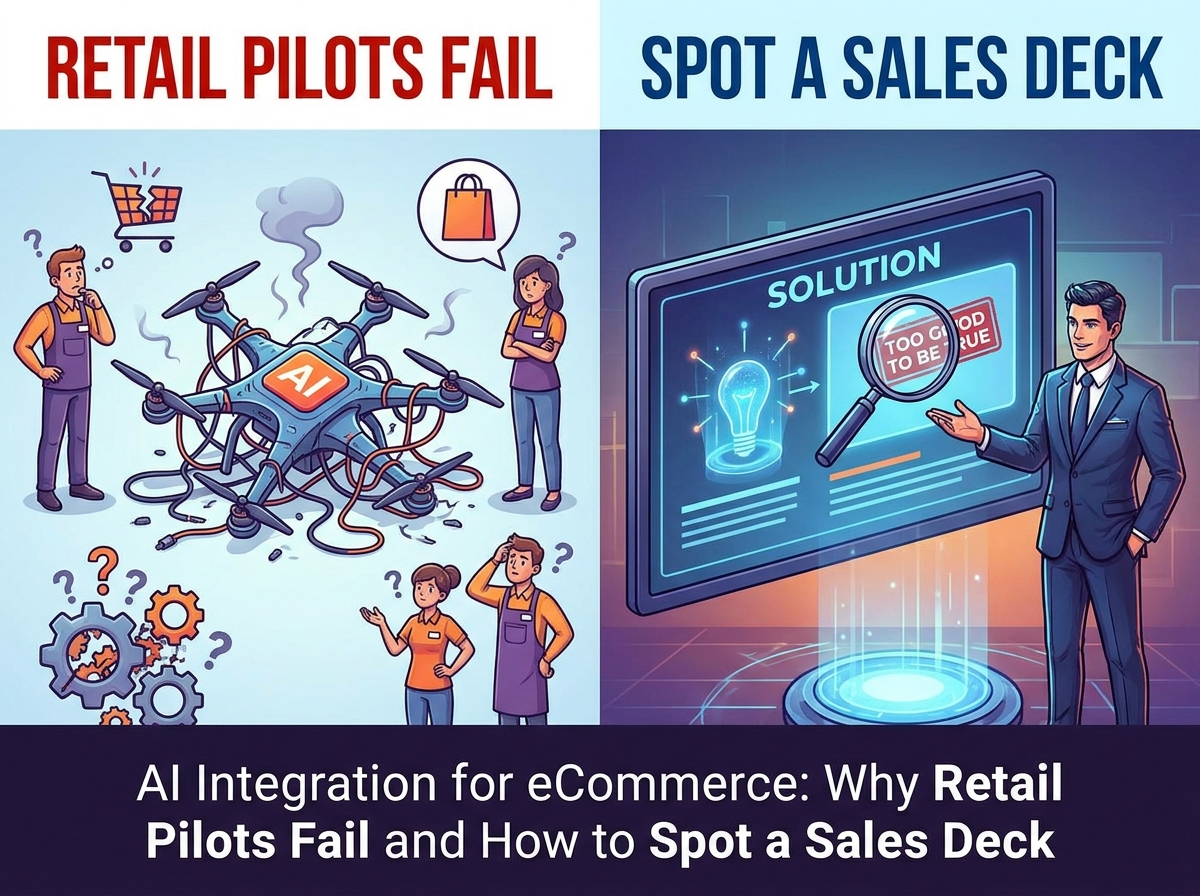
A home goods retailer’s AI chatbot answered product questions correctly for eleven weeks. Then a supplier changed a return policy’s wording, nobody updated the bot’s source material, and it quoted the old terms for six more weeks. No one was watching the transcripts, so no one caught it until a customer complained.
That is not a story about a bad model. Shopify credits part of its 31.6% GMV growth in Q2 fiscal 2026 to AI commerce features, so the technology clearly can work. The gap between that outcome and the chatbot above has nothing to do with the model, and everything to do with what happened after launch.
Key takeaways
Shopify reported GMV of $115.57 billion in Q2 fiscal 2026, up 31.6% year over year, crediting part of that growth to AI commerce features — proof integration works when someone keeps owning it past launch.
Shopify reports 92% merchant retention above $1 million in annual GMV and 97% above $10 million; retention that high depends on tools merchants keep using, not tools they
merely piloted.
B2B GMV rose 76% year over year, per the same disclosures — the segment where exception rules break silently fastest without human review.
US e-commerce reached 17.1% of total US retail sales, per US Census Bureau reporting — enough volume that one unreviewed error compounds across thousands of orders. No audited, industry-wide failure rate exists for retail AI pilots; a specific percentage quoted without a named source in the same sentence is a sales claim, not a fact.
Why do most AI pilots in retail fail before they scale?
Most fail for operational reasons, not technical ones: no defined success metric, data nobody validated past the demo, no person accountable when the system is wrong, no visibility into whether it is working, a use case chosen because it demos well, and ownership that disappears once launch gets announced as done.
None of that requires a bad model. A well-built assistant fails as easily as a mediocre one if nobody defined success, nobody stress-tested the data, and nobody stayed accountable once the launch party ended.
What is AI integration for eCommerce?
AI integration for eCommerce is the work of connecting machine-learning or generative-AI systems into a store’s live operations — search, support, merchandising, fulfillment — so the system reads and writes real data instead of running against a curated demo. Most project risk lives in how deep that connection actually goes.
That is a different skill from theme-level Shopify development. Vendors selling AI development services vary widely here — the gap between reading a product feed and writing to an order system is where most cost and risk concentrate.
Why does a pilot with no defined success metric always drift?
A pilot survives its first month on enthusiasm. Without a written target — queries resolved without escalation, minutes saved per order, an error rate under a stated threshold — nobody can say when it succeeded, so it runs on momentum until a budget review forces the question.
“Improved customer experience” is a mood, not a metric. A real one has a number, a denominator, and a date it gets checked, agreed before the contract is signed.
Why does data that looked fine in the demo fall apart in production?
Demo data is curated: a clean feed, consistent categories, tidy formatting. Production data rarely matches — duplicate SKUs, inconsistent attribute formats, return policies that vary by region, inventory counts that lag the warehouse. A system built against the demo set inherits every one of those inconsistencies once it goes live.
Buyers catch this latest, since it looks fine on day one and degrades as edge cases accumulate. The fix: before signing, test against a real, unfiltered slice of your own order
history, not the vendor’s sample.
What happens when there is no human escalation path?
Without a named person authorized to review and override output, a wrong answer repeats at machine speed until a customer complains loudly enough to reach someone with authority. By then the error has usually reached hundreds of orders, not one.
Observability compounds it. Many deployments log nothing a human reads: no transcript sample, no error-rate dashboard, no alert when confidence drops. Without that visibility, “is this working” gets answered with impressions, which favor whoever wants the answer to be yes.
How can you tell a real AI proposal from a sales deck?
A real proposal names a metric, a data-quality process, an escalation owner, and a maintenance budget before the demo happens. A sales deck leads with the demo, picks a use case chosen for how well it presents rather than how often it runs, and goes quiet on who owns the system ninety days out.
Two tells matter most. Ask what happens on day 91, after the launch announcement: firms offering AI integration for eCommerce as a standing service, not a one-time build, tend to answer that honestly. And ask how the use case was chosen — a high-volume, low-glamour task like return routing beats an assistant that shines in a boardroom and rarely runs in the warehouse.
What questions should you ask before you sign?
Four questions expose most weak proposals: what happens when the system is wrong, who reviews its output, what this costs per thousand requests, and what the vendor is obligated to do on day 90. A proposal that cannot answer all four in writing is not ready to sign.
Vendors often quote a flat monthly fee during the pilot, hiding the marginal cost per request once volume scales past the trial tier. Ask for a per-thousand-request figure tied to actual usage, not a bundled retainer, and insist the reviewer named is a person, not “the support team.” A proposal built to survive one good demo answers none of this; one built to be owned answers all of it.
Frequently asked questions
What does AI integration for eCommerce cost per thousand requests? There is no universal figure; cost depends on the model, request complexity, and volume. Ask for a per thousand-request cost tied to actual usage rather than a flat monthly number, so pricing scales predictably instead of surprising you at renewal.
Who should review AI output in a retail operation? A named individual with authority to pause or override the system, not a shared inbox or rotating team. Reviews should sample real transcripts on a fixed schedule rather than rely on customers to report errors, since most who get a wrong answer just leave.
How long should a retail AI pilot run before anyone calls it proven? Long enough to include a full order cycle and one data anomaly — a supplier change, a stockout, a policy update. Ninety days is a reasonable minimum, but the better test is whether the system still has a named owner and a documented review process on day 90.
Figures are drawn from Shopify Inc.’s Q2 fiscal 2026 earnings disclosures and US Census Bureau retail e-commerce reporting. Editorial brief; not commercial advice.