Why Geography & Tech Design Skills are the New Academic Powerhouse for Students

The modern academic landscape is shifting. Gone are the days when subjects existed in silos, independent of one another. Today, the most successful undergraduate students are those who can bridge the gap between physical understanding—Geography—and digital execution—Tech Design. This intersection is creating a new “academic powerhouse” persona: a student who understands the world’s spatial constraints and possesses the technical prowess to build solutions within them.
As the global economy becomes increasingly digitized, the demand for students who can visualize data and design infrastructure has skyrocketed. However, the pressure to master these diverse fields simultaneously can be overwhelming. Many students find that managing complex research papers alongside technical labs is a significant hurdle. In such cases, leaning on a professional assignment writing service like Myassignmenthelp can provide the necessary structural support, allowing students to focus on mastering the core concepts of spatial analysis and digital architecture without falling behind on their deadlines.
The Evolution of Spatial Intelligence
Spatial intelligence is no longer just for cartographers. It is the foundation of urban planning, environmental science, and even logistics. When a student studies Geography, they aren’t just memorizing capitals; they are learning how human systems interact with the environment.
When you pair this with Tech Design skills, you get a “Digital Architect.” This combination allows a student to look at a piece of land and not only understand its environmental impact but also design a sustainable structure using advanced software. This dual-competency makes a graduate indispensable in the 2026 job market.
Technical Proficiency: The Rise of CAD in Global Education
One of the most critical tools in this new academic era is Computer-Aided Design (CAD). Whether you are studying civil engineering, interior design, or environmental management, the ability to create precise, 3D representations of physical spaces is a non-negotiable skill.
However, the learning curve for software like AutoCAD is notoriously steep. Students often spend hours trying to figure out layers, dimensions, and rendering techniques while their other coursework piles up. To maintain their grades during these intensive learning phases, many choose to seek specialized autocad assignment help from Myassignmenthelp. This expert guidance ensures that their technical drawings are accurate and professional, reflecting the high standards required in global engineering and design sectors.
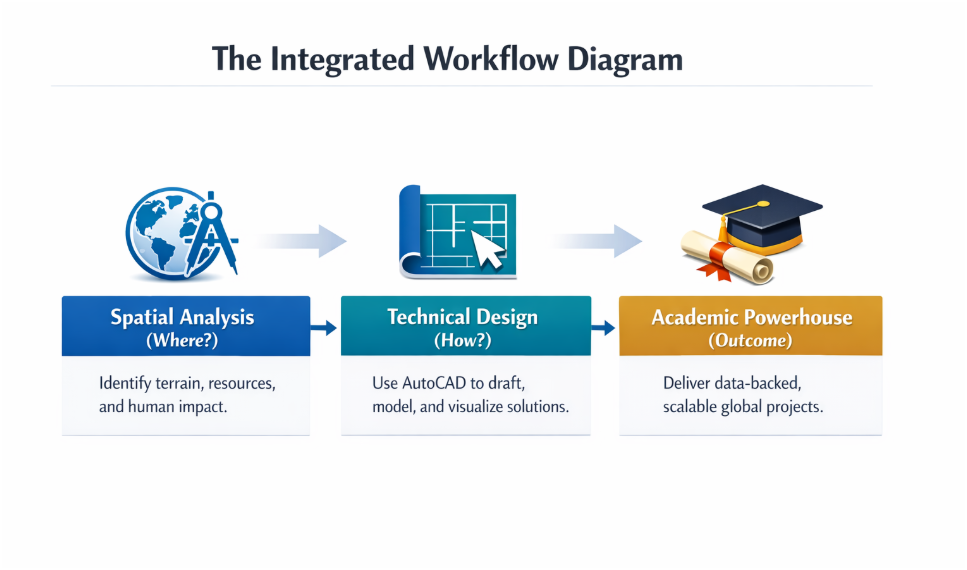
Comparison: Traditional Learning vs. The Powerhouse Approach
| Feature | Traditional Academic Path | The Powerhouse (Geo + Tech) |
| Focus | Subject-specific memorization | Cross-disciplinary application |
| Toolbox | Standard essays and exams | 3D modeling, GIS, and Data Viz |
| Global Reach | Localized context | International standards & scalability |
| Marketability | High in a narrow field | High across multiple industries |
Why Global Universities are Changing Their Curriculums
Universities in the UK, US, Australia, and Canada are increasingly offering “Integrated Degrees.” They recognize that an engineer who doesn’t understand geography is a liability, and a geographer who can’t use design tech is limited.
For an undergraduate, this means the workload has become more technical. You are expected to be a writer, a designer, and a scientist all at once. This “Global Tone” in education emphasizes versatility. It’s about being able to present a project to a board of directors in London as easily as you would to a construction team in Dubai.
Improving Your Dwell Time: Mastering the “Deep Work” Phase
To rank among the top of your class (and to ensure your own “content” or knowledge ranks well in the professional world), you must master deep work.
- Phase 1: Geographic Research. Understand the “where” and “why.”
- Phase 2: Technical Drafting. Use software to bring the “where” to life.
- Phase 3: Synthesis. Write reports that explain the synergy between the two.
If you find yourself stuck in Phase 3, remember that professional editing and academic consultation can help refine your voice, ensuring your work sounds like a seasoned professional rather than an entry-level student.
The Future of Academic Success
The future belongs to the “T-shaped” student: someone with deep expertise in one area (like Tech Design) and a broad reach in others (like Geography and Humanities). By embracing both the physical and digital worlds, you aren’t just passing a class; you are future-proofing your career against AI automation and market shifts.
Stay curious, use the tools available to you—whether they are advanced design software or academic support services—and keep pushing the boundaries of what a modern student can achieve.
Frequently Asked Questions (FAQ)
1. Why is Geography considered a “tech” subject now?
Modern Geography relies heavily on Geographic Information Systems (GIS) and satellite imagery, making it a data-driven technical field that requires significant digital literacy.
2. Is it okay to use academic support services for technical assignments?
Yes, many students use services like Myassignmenthelp to understand complex software or to see examples of high-quality work, which serves as a learning bridge for their own future projects.
3. What are the best design skills for Geography students?
Learning AutoCAD, Rhino, or GIS software is highly recommended for any student looking to enter urban planning or environmental engineering.
4. How can I balance technical design labs with essay writing?
Effective time blocking is key. Dedicate your peak energy hours to technical design and use your evening hours for research and writing, or outsource the drafting phase to professional services to maintain a healthy balance.